


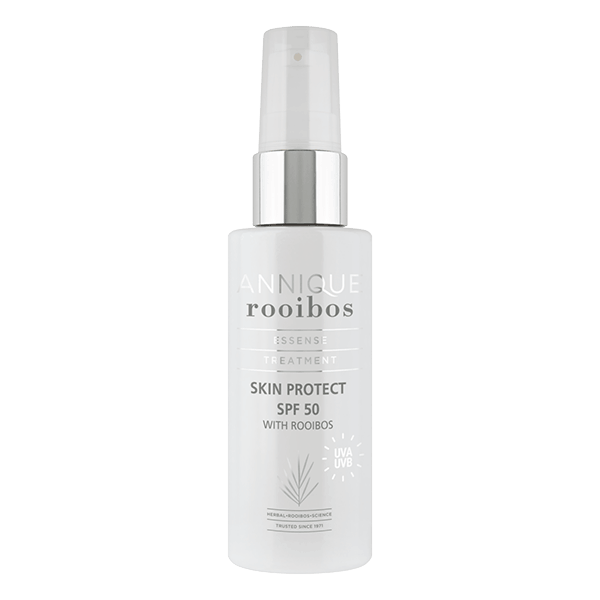
Your skin is exposed to UV rays every single day, even through clouds, windows and heat. UV damage is the number 1 cause
of pigmentation, premature ageing, uneven skin tone and fine lines. Sunscreen is not optional — it is essential for daily anti-ageing and pigment protection. And when it comes to beauty and skin health, prevention far outweighs correction.
Not All Sunscreens Are Created Equal
- High-performance + broad-spectrum (UVA + UVB) protection
- Ideal for pigmentation-prone skin
- Lightweight, elegant texture — daily wearable
- Stable, long-lasting and highly effective
- Perfect for sensitive skin & long-term use
Protect your skin daily with our premium Essense Skin Protect SPF 50, a high-performance, broad-spectrum
sunscreen specially formulated for sensitive skin. This ultra-light, fast-absorbing formula uses cutting-edge sun filter
technology paired with gentle care to deliver powerful UVA and UVB protection.
Infused with Rooibos, known for its natural antioxidant properties, it helps soothe and support the skin barrier while
shielding against environmental stressors.
Fragrance free.
Dermatologically tested.
Why Is Using Sunscreen Important?
Daily sunscreen is one of the most important steps in your skin care routine because it protects your skin from the
single biggest cause of premature ageing and long-term damage: UV radiation.
- Prevents premature ageing
Up to 80–90% of visible ageing (wrinkles, sagging, pigmentation) is caused by sun exposure. - Reduces the risk of skin cancer
UV rays can damage skin cells at a DNA level; SPF use lowers long-term cancer risk. - Protects against pigmentation and dark marks
Helps prevent melasma, post-acne marks and uneven skin tone from worsening. - Maintains a strong skin barrier
Protects sensitive or compromised skin from irritation and inflammation. - Necessary all year round
UV penetrates clouds and windows — making SPF essential daily. - Supports overall skin health
Reduces oxidative stress and inflammation, aiding smooth, clear skin.
What Does SPF Mean?
SPF stands for Sun Protection Factor and refers to how well a sunscreen protects against UVB rays.
The SPF number shows how long it would take for your skin to redden compared to no protection.
Example calculation (if your skin reddens after 10 minutes unprotected):
- SPF 20: 10 minutes × 20 = 200 minutes (~3 hours 20 minutes)
- SPF 50: 10 minutes × 50 = 500 minutes (~8 hours 20 minutes)
Important:
- This is a theoretical calculation.
- Real-world factors reduce actual protection (sweat, rubbing, heat, uneven application).
- Reapply every 2 hours regardless of SPF number.
What Does “Dermatologically Tested” Mean?
It means a product has been evaluated under the supervision of a dermatologist to ensure it is safe for human skin.
- Gentle on most skin types
- Does not cause unnecessary irritation when used as directed
- Safe for regular, everyday use
It does not mean the product is hypoallergenic or guaranteed to suit everyone, but it provides an additional
level of reassurance and safety.
Comparison: Derma Protect SPF 20 vs Skin Protect SPF 50
| Category | Derma Protect SPF 20 | Skin Protect SPF 50 |
|---|---|---|
| Type of Sunscreen | Mineral-based | Modern organic (carbon-based) filters |
| Protection Level | Moderate (±95% UVB blocked) | High (±98% UVB blocked) |
| UVA Protection | Good, limited by mineral-only system | Excellent – UVA1 + UVA2 |
| Skin Feel | Rich, creamy, occlusive | Lightweight, silky, fast-absorbing |
| Finish | Can leave a white cast | Clear, invisible finish |
| Skin Types | Best for dry or compromised skin | Suitable for all skin types |
| Texture Style | More oil-based; nurturing | Modern, elegant, non-greasy |
| Make-up Compatibility | Heavier under make-up | Excellent under make-up |
| Climate Suitability | Better for cool weather; heavy in heat | Ideal for South African sun; year-round comfort |
Sunscreen Analogy: Sponge vs Umbrella
SPF 50 (Organic/Carbon-Based Filters) → “The Super-Absorbent Sponge”
- Absorbs far more UV rays before they reach your skin
- Neutralises UV energy safely and efficiently
- Designed for high-UV environments like South Africa
Result: Better protection against dark marks, ageing, redness and long-term damage.
SPF 20 (Mineral + Basic Filters) → “The Small Protective Umbrella”
- Blocks/scatters some UV rays
- Coverage is limited compared to SPF 50
- Best for short, everyday exposure
Result: Still protective and gentle, but offers significantly less defence.
Why SPF 50 Is Better
- Bigger Sponge = More Protection
SPF 50 absorbs nearly twice as much UVB as SPF 20. - Longer-Lasting Protection
SPF 20 saturates much faster under strong UV. - Superior UVA Protection
Essential for melasma, pigmentation and ageing concerns. - Better Cosmetic Feel
Modern SPF 50 formulas are now lightweight and elegant.
Why SPF 50 became more desirable than SPF 20 in modern skin care
Over the last 10–15 years, SPF 50 has gradually become the preferred choice in cosmetic skin care due to major scientific, formulation and consumer shifts. Growing global awareness of sun damage highlighted that SPF 20 blocks roughly 95% of UVB rays, while SPF 50 offers about 98% protection—an important difference when it comes to preventing pigmentation, premature ageing and cumulative UV damage. As anti-ageing and preventative skin care became key industry drivers, consumers increasingly looked for higher levels of daily protection. At the same time, modern UV filter technology transformed the texture of high-SPF formulas: where older SPF 50 products felt thick or greasy, new-generation formulations from 2018 onwards are lighter, more elegant and suitable for all skin types. Dermatologists also standardised their recommendations, promoting SPF 30–50 for everyday use, especially in high-UV regions like South Africa. Added to this, social media and beauty influencers made SPF 50 a global benchmark for healthy, well-protected skin. As a result, between 2015 and 2020, SPF 50 shifted from being seen as “too heavy” to becoming the industry gold standard in modern skin care.


